Verified > 99% Lab-grade Peptides
Peptide Top Quality: Significance Of Third-party Recognition
At Maxed Out Substances, every item we supply comes with a clear screening record and clear paperwork. Our objective is to support scientists with high-purity, verified substances that meet the demands of contemporary clinical research study-- absolutely nothing even more, nothing much less. Independent, third-party testing plays an essential function in ensuring objectivity and precision. By using external labs for verification, vendors eliminate prejudice and uphold scientific reliability. It's an additional action that gives scientists self-confidence that each peptide meets constant, proven requirements. This grade matches most of artificial insemination study applications-- receptor binding assays, enzyme task researches, and cell culture experiments.- A lot of peptide vendors and research labs rely upon several reputable analytical approaches.
- Purity varies commonly, from 40% to 80%+ relying on series size and trouble.
- HPLC tells you what proportion of your example is the main compound-- yet it does not confirm what that main compound actually is.
- Tests can be carried out utilizing high-precision stabilization chambers, mimicing various atmospheres, and applying worldwide standards to research short-term and lasting security, essential for regular peptide performance.
- As long as you acquire peptides from a trusted source that gives a full certificate of analysis, you can be positive in the peptide's pureness grade and usage range.
What Can We Supply?
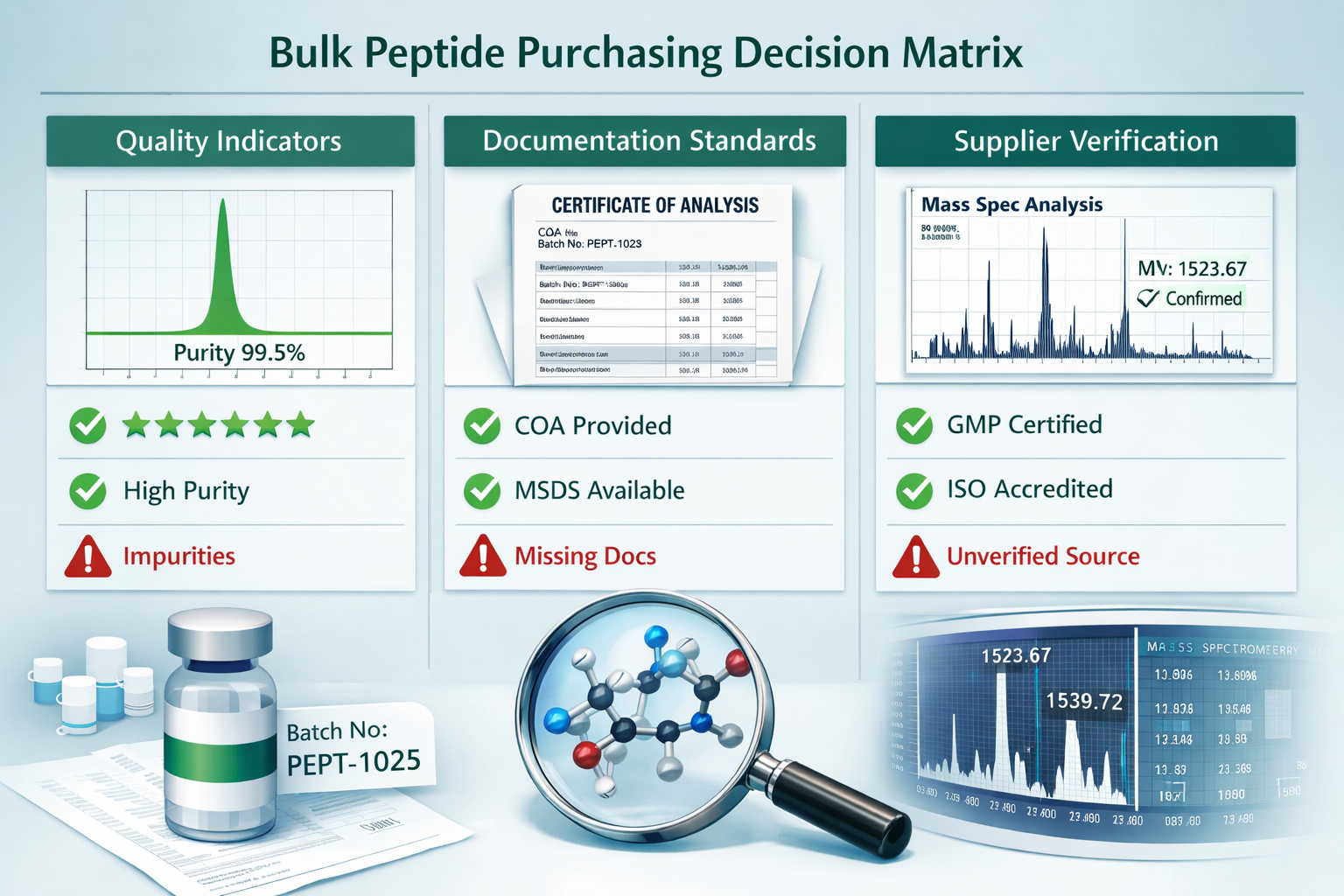
Not every application needs 99% pureness, and filtration is a significant element of peptide manufacturing expense. Trace amounts of solvents utilized during synthesis and filtration-- acetonitrile, dimethylformamide (DMF), dichloromethane-- can remain in the final product. These are commonly existing at very low levels in appropriately manufactured peptides and are regulated by ICH Q3C guidelines for appropriate limits. If the target peptide's height represent 99.1% of the total optimal location, the peptide is reported as 99.1% pure by HPLC. Numerous credible research peptide suppliers utilize third-party laboratories; some conduct internal screening with magazine of laboratory credentials.
In vivo examinations evaluate absorption, distribution, metabolic process, and discharging (ADME) qualities, even more validating effectiveness and safety. These testing solutions not just help customers optimize items precisely during growth but also give strong information support for governing conformity of peptide formulations. Be cautious of COAs that supply a purity number with no supporting chromatographic data, report pureness without specifying the analytical method, or checklist a molecular weight without mass spectrometry confirmation. Tandem mass spectrometry (MS/MS or MS ²) fragments the peptide ions in the gas stage and analyses the fragment masses. This is the gold standard for peptide identity-- it validates both the composition and the sequence. For numerous peptide jobs, absolute peptide amount matters as high as chromatographic purity.Significantly, this purity number is commonly determined after filtration (e.g. https://andersonwsaf621.publishlane.com/posts/peptide-synthesis-leading-methods-and-tips by HPLC) and concentrates on peptide contaminations-- it does not count recurring water, salts, or counter-ions in the dried peptide powder. To put it simply, the pureness percentage is about the structure of peptide varieties in the sample, not the weight payment of water or salts. A peptide might be 98% pure (meaning extremely couple of peptide impurities) yet still contain some water or trifluoroacetate salt; those non-peptide elements would be mirrored in the web peptide material as opposed to the pureness percent. At Creative Peptides, we provide custom-made peptide chemical and physical evaluations for study teams that require dependable information on peptide identification, pureness, make-up, service habits, and sample quality. Our solution sustains synthetic, modified, cyclic, conjugated, and hard peptide examples with analytical process built around the actual project concern as https://franciscowmyv492.dovetailscope.com/posts/leading-10-peptide-business-in-the-united-states-finest-ranked-suppliers-2026-guide opposed to a taken care of default panel.
What Peptide Testing Can And Can Not Show
These are useful in the best setup, but they need to be interpreted as method-specific proof instead of a global replacement for HPLC and MS. However peptide pureness is probably the solitary crucial high quality metric for any study peptide. It directly impacts the dependability and reproducibility of speculative outcomes. A peptide provided at 75% pureness and one at 99% purity aren't simply different qualities-- they can generate meaningfully various end results in the very same assay.
Need Paperwork Prior To Getting?
Straight from the synthesizer with minimal handling-- normally simply cleavage from the material and rainfall. Purity ranges extensively, from 40% to 80%+ depending upon sequence length and difficulty. Unrefined peptides appropriate for applications where purity isn't important, such as antibody production or initial testing assays where the target peptide just needs to be existing, not dominant. Very closely associated with truncations, deletion peptides are full-length chains that are missing one amino acid somewhere in the center. If topping isn't completely efficient, an uncoupled chain can remain to lengthen in subsequent actions, creating a peptide that's just one residue except the target.
Nonetheless, achieving ultra-high purity (state 99%) can be practically challenging and might not constantly be required, as we'll go over later. The trick is comprehending what level of pureness suffices for your demands and how pureness is determined in the first place. For the majority of study functions, high purity means you can be certain that the huge majority of the particles in your vial are the right peptide, which helps make sure speculative consistency and reproducibility. Our process is developed to move from sample context evaluation to interpretable peptide data with marginal analytical ambiguity. Jobs can vary from one sample identity check to multi-lot comparability, residual evaluation, solubility evaluation, or stability-focused analytical plans. Hydrophobic peptides, highly standard sequences, changed constructs, and closely relevant analogs can be examined with technique changes matched to their logical threats.